November 23 is Fibonacci Day, a celebration of one of the most recognizable patterns in mathematics. Written as 11/23, the date represents the beginning of the Fibonacci sequence: 1, 1, 2, 3, 5, 8, 13…
At North Dakota’s Gateway to Science, we love exploring the connections between math, science, and the natural world. Fibonacci Day is a great opportunity to discover how mathematical patterns appear in everyday things, from flowers to pine cones.
What Is the Fibonacci Sequence?
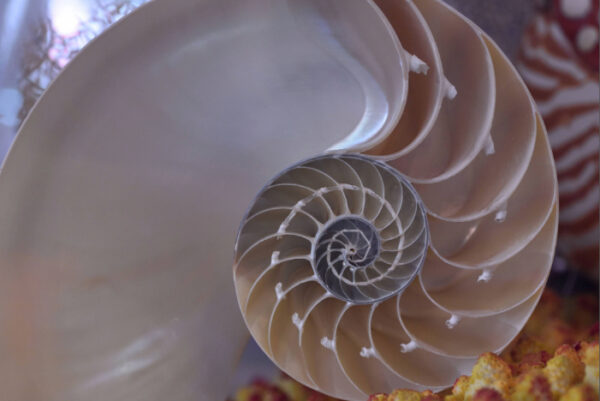 The Fibonacci sequence is a series of numbers where each number is the sum of the two numbers before it.
1, 1, 2, 3, 5, 8, 13, 21, 34…
For example:
- 1 + 1 = 2
- 1 + 2 = 3
- 2 + 3 = 5
- 3 + 5 = 8
The sequence is named after Italian mathematician Leonardo Fibonacci, who helped introduce it to Europe in the early 1200s.
Fibonacci Numbers in Nature
Fibonacci patterns appear in many natural structures, especially in plant growth. Look closely at:
- Sunflowers: Seeds often form spirals in opposite directions, with spiral counts that correspond to Fibonacci numbers.
- Pine cones and pineapples: Their scales and sections often form intersecting spiral patterns.
- Flower petals: Some flowers have petal counts that are Fibonacci numbers, such as 3, 5, 8, or 13.
- Leaves: Their arrangement around a stem can follow patterns related to the sequence, helping plants make efficient use of sunlight and space.
What Is the Golden Ratio?
The Fibonacci sequence is also connected to the Golden Ratio, approximately 1.618. As Fibonacci numbers grow, the ratio between consecutive numbers gets closer to this value.
The Golden Ratio has fascinated mathematicians, scientists, artists, and designers for centuries, with connections to natural patterns, art, and design.
Explore Meaningful Math at Gateway to Science
Fibonacci Day reminds us that math goes beyond textbooks and classrooms. From flower petals to pine cone spirals, mathematical patterns are all around us!
At North Dakota’s Gateway to Science, visitors can explore the connections between math and everyday life through our Meaningful Math activity stations.
Infinite Possibilities is part of Meaningful Math: Museum and Community Partnerships, engineered by The Franklin Institute and supported by the Simons Foundation through its Infinite Sums initiative.
Learn more at meaningfulmath.fi.edu.